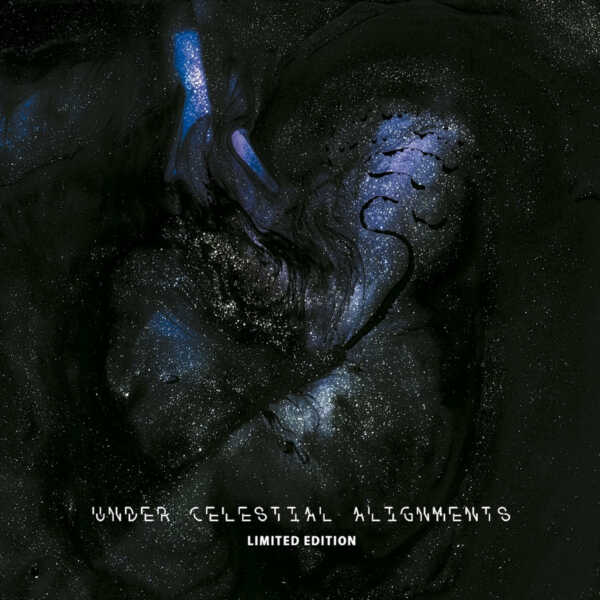
There are bands that make music, and others that use it as a pretext to create something that goes beyond that. I’ve always had a soft spot for Nordic Giants for this very reason: Rôka and Loki, the two musicians behind the project whose real names no one knows, have built a universe around their creation, with a care that transforms every element into part of a single design. They take the stage masked in feathers and animal skins, shrouded in fog, with immersive short films projected behind them; and behind those masks there is no room for ego, sacrificed in favor of the evocative power of the music and the almost sensory intensity of the images. In 2024, they revisited their early work with Origins, a compilation of re-recorded and remastered EPs and singles; Under Celestial Alignments, four years after Symbiosis, is their first album of new material since then. I mentioned the universe earlier for a reason, because this time even the artwork points in that direction, quite explicitly so. What at first glance appears to be a photo of the James Webb space telescope is actually a macro photograph of chemical reactions in Petri dishes. The symbolism is all right there: the idea of the cosmos recreated from something microscopic, the familiar and the intimate opening up to something boundless. It is the very poetics of the album, already written on the cover, and in a truly original way, no less.
I believe the most important word in the title is “Under.” Being beneath the celestial alignments implies a very specific posture: we are looking up, as tiny human beings. As Cooper said in Interstellar: “We used to look up at the sky and marvel at our place among the stars. Now we only look down and worry about our place in the dust.” That is exactly what this album does: it shifts the vantage point from our small yet great Earth to the sky, with all the grandeur that entails. It is also the first time that Nordic Giants have released an entirely instrumental work, without guest appearances or sampled vocals, which they have always used to convey messages about the human condition and stir consciences; this time there is no Freyja, my favorite among the guests on previous albums, to move us with the sweetness of her ethereal timbre. It is, however, an absence that fits well with the album’s poetics: if there are no voices to guide us, it is just us and the immensity of the cosmos above our small gazes, together with this transcendental music that exerts its strange power over our minds. The piano melodies, the undisputed lead instrument, hold every element of the work together; the hypnotic phrasing drifts off into unpredictable digressions before returning to itself, each time with greater weight, while the saturated drums follow every shift in intensity with almost telepathic precision. Everything surrounding this inseparable pair, in my view, represents the universe and the mystery of the unknown: there are synthesizers and pads soaring through space like ancient alien creatures, cinematic strings scattered across outer space like asteroids, sonic architectures that in certain passages reach the same alienating vastness as Hans Zimmer’s score for Dune. The music builds emotion by withholding before granting it, and one gets the impression that the piano notes represent human beings with their limited perception, overwhelmed by a force without origin or boundary. The magnificent conclusion of “Torus,” the first single released alongside a beautiful video I highly recommend checking out, is the clearest example of this, with the gradual nature of its progression patiently transforming into a majestic climax. Another characteristic of all the tracks is the almost soothing role of the drums, which always follow the piano’s rhythm even in moments of contemplation (“ “In The Half Light,” the track most reminiscent of the luminous atmospheres of Symbiosis), but also embracing the sound and pulling it toward more euphoric shores (“Red Falls” and its initial melancholy embraced by the infectious enthusiasm of the snare drum). This is an album structured to patiently convey a sense of peace in the opening tracks (the initial triptych is exemplary in this regard), only to deliberately shatter it when the soul feels most secure. It is the splendid “Reaper” that betrays this promise, and it does so with a courage that gave me the deepest chills of the entire album. I believe this is truly the emotional climax of the tracklist; it’s the exact moment when serenity is thrown into crisis by something dark and unresolved that transforms sweetness into danger. Just when the music seems to want to act as a shield against this anxiety-inducing tension—suggesting that even the inexplicable is part of a reassuring plan—that feeling is promptly stripped away. It’s a track that doesn’t resolve itself, sacrificing any cathartic impulse in favor of a descent into the abyss of uncertainty; musically, we’re in the fluctuating constellation of doubt, and we can do nothing but traverse it, facing the danger head-on even if it frightens us. “Clouded Minds” amplifies it all with a crescendo bordering on the claustrophobic, with the drums growing ever more relentless amid the frenzied piano notes; but suddenly here we are in another, clearer dimension, on the other side of the black hole. Here is the magic of Nordic Giants in all its glory: it feels as though we suddenly find ourselves observing the Earth’s shades of blue from a spaceship, submerged in interstellar dust, in a sort of ecstatic contemplation that dissolves every shadow, replacing it with the light of gratitude. And so the final peace of “Seren,” with piano and synthesizers expanding into a melancholic yet vibrant tapestry, makes us feel in total harmony both with what surrounds us and with what we cannot see, but whose essence we perceive.
Under Celestial Alignments, ultimately, is an album that teaches us to dwell within the incomprehensible without letting it frighten us. The humanity of the piano melodies always exists in dialogue with the boundless grandeur of the soundscapes, and the work does not seek to reconcile the two planes so much as to show that they can—indeed, must—coexist. There is a mature sense of acceptance in these compositions, the idea that we can be part of a world much larger than ourselves with our eyes open and our hearts capable of receiving everything that comes our way—even what we cannot explain—remaining within the unpredictability without feeling the need to decipher it. And with all the problems in the world today, it is natural and human to look down, yet the Nordic Giants remind us that there are still sonic universes capable of making us look up and marvel at our place among the stars.