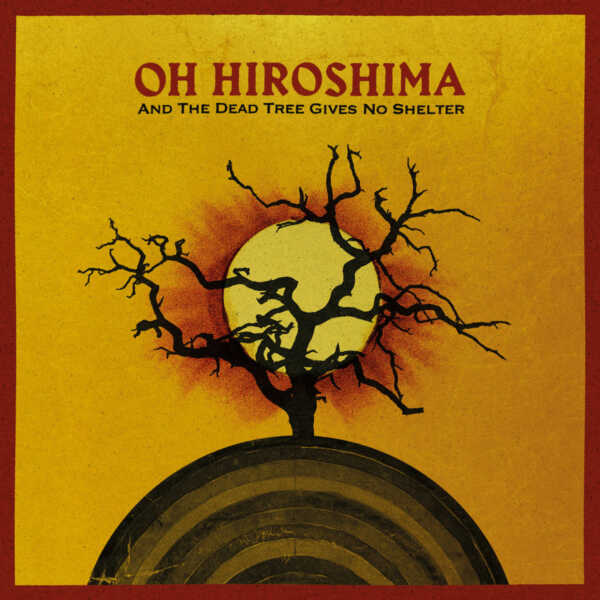
I’ve always had a sort of obsession with trees. I’m not quite sure why, perhaps it’s because, compared to the noise of our busy little lives, trees have such a peaceful and elegant way of existing in the world. In the rush of everyday life, I often find myself stopping to watch the lush foliage swaying in the wind, and every time, it’s as if my soul feels safer. Bare trees, on the other hand, have always conveyed a deep sense of vulnerability to me. The image of bare branches reaching toward the sky like hands stretched out into the void has always made me think of the desolate beauty of an old shelter that hasn’t offered protection for quite some time. With And the Dead Tree Gives No Shelter, the sixth album by Oh Hiroshima, we delve right into this kind of feeling. The cover already hints at this: that solitary tree silhouetted against a pale sun immediately reminded me of the artwork for Solace, the masterpiece by Jakob, even though the background there was red. The title draws on a line from The Waste Land by T.S. Eliot, and for Jakob Hemström, the band’s main composer, that lifeless tree is a metaphor for a kind of withdrawal from the world. When no concrete way out of difficulties is in sight, one tends to develop this sort of armor of cynicism as a form of self-defense: to avoid further disappointment, one may isolate oneself, effectively shutting out the very authentic experiences that make life worth living. A loneliness that Oh Hiroshima know all too well in reality: with the founding guitarist and bassist having left the group, only Hemström’s brother Oskar Nilsson remains on drums; this time, however, they’ve brought a dozen musicians on board, infusing their post-rock DNA with a strong progressive influence. All this just two years after All Things Shining, which I consider, all things considered, a good album, but which, to be honest, felt somewhat repetitive in places.
I therefore approached this new work with great curiosity, and right from the start I found an energy within it that makes listening to it far less nihilistic than the title would suggest. Scattered throughout the tracks, I sensed this strong determination to leave behind the dead weight of our existence; the entire work thrives on this constant contrast between moments of introspection and sudden bursts of energy, where the sections of decay suddenly spring back into motion, effectively moving away from a completely intentional stillness. When this balance works, the album reaches great heights; in “Skeleton Key,” for example, the prog ambition blends perfectly with the band’s style: the opening with the distorted bass builds a very tense atmosphere, which is enhanced by Hemström’s compelling vocals; then the percussion kicks in, and that tension finds release only in the guitar riffs. Sections that are very different from one another coexist and follow one another naturally; the finale also features beautiful backing vocals that give way to an unexpected return of heavy sounds. Also noteworthy is the veiled melancholy with an almost folk flavor of “Ivory Town,” a very moving track in which the opening textures rest on the piano notes of Jarl Furingsten and ethereal string arrangements. The nostalgic atmosphere and the song’s progression reminded me of Opeth’s Damnation, but I also detected a touch of Steven Wilson and Lunatic Soul by Mariusz Duda. Emotionally, the fragility that characterizes the entire soundscape stands out, before the decidedly more earthly conclusion; here too, I sense a strong desire to shake off all anxiety in order to get back on the road. It is, in fact, a realistic hope that I feel in the soul of the most successful tracks, a sort of pragmatism rooted in the necessary steps to take in search of a new shelter. It is also perceptible in the sense of movement in “Meridian,” a track with a strong progressive feel where the frantic interplay between acoustic guitar and crystalline riffs opens into a more contemplative passage. In the interplay between the two stereo channels, the rhythm guitar on the left almost feels like a friend’s pat on the back telling you it’s time to move on without sugarcoating it, whatever the obstacle, before the intensity of the vocals seals the finale, preserving all its gravitas. But in my opinion, the culmination of these new influences lies entirely in the seven minutes of “Exit Cloud,” undoubtedly my favorite track on the album. The tension is palpable from the very first seconds, in a massive, almost symphonic crescendo with post-metal elements, suddenly broken by a dramatic shift (the first of many): the delay-laden clean guitar riffs race wildly to opposite sides of the stereo, then an almost oriental string progression creeps in, marking the exact moment when the light of hope breaks through the wall of sound, making everything wonderfully unpredictable. It is only at this point that the vocals enter, with a tone reminiscent of the more melodic and clean Mikael Åkerfeldt, and are used almost as an instrument to accompany the track toward the final explosion. A veritable avalanche that gave me back the same sensory rapture I felt back in the days of In Silence We Yearn, even though, paradoxically, I’ve never heard Oh Hiroshima play so freely. The flip side of this freedom on the album is that this expansion toward less conventional structures leaves the band vulnerable in moments when they overdo the lulls, slipping into a weary tension that ends up spinning its wheels. This is what happens on “Broken Sunlight,” a track that fails to justify the repetitiveness of its central section; the main clean guitar lick isn’t convincing, and the restart of the saturated prog-style bass isn’t enough to save a payoff that comes too late. A similar weariness also surfaces in the bridge of “Tree of Life,” where the same bars are repeated four times in a row while waiting for a change that, when it arrives, sounds interesting but decidedly lopsided and unpolished, leaving the feeling that it still needed work. And in all this, a separate reflection must be made on the handling of the vocals. Oh Hiroshima have always used vocals in an impressionistic way, treating them as a distant texture immersed in the mix. Where the album veers toward the traditional song form, pushing the vocal lines to the forefront as in “Angelos” or “Broken Sunlight” itself, the music at times lazily serves the vocals, and the progressions become, for my taste, a bit too conventional. The problem isn’t so much the presence of the vocals as their weight within the track: in “Servant of All,” for example, the vocals are present and play an important role on par with all the other instruments, yet they never fall into that tiring effect. This short-circuit tends to slow down the development of certain passages, trivializing the sound just a bit where the album would have benefited from a few more flashes of brilliance.
Despite this, And the Dead Tree Gives No Shelter remains a decidedly more inspired work than its predecessor. While in All Things Shining the decision to darken the sound too much and keep it more closed off ended up flattening some key tracks, here the production takes a clear step forward, finally finding a greater sonic openness and a brilliance that were at times lacking last time. In this sense, the third consecutive collaboration with Magnus Lindberg proves decisive: his crystal-clear mixing and mastering work enhances an album that thrives on significant peaks of quality and has the merit of not wallowing in its own pain, offering listeners a concrete push to react and not feel stuck. It’s just a shame about those passages where the slowdowns lack bite; I think that in the future, Oh Hiroshima should take a little more time to prune a few too many dead branches from their songs. The fact remains that when the two Swedes decide to take a risk, the wild beauty of their music sweeps everything away, confirming the undisputed value of a band that still knows how to move people.
(Pelagic Records, 2026)
1. Servant of All
2. Meridian
3. Angelos
4. Skeleton Key
5. Tree of Life
6. Broken Sunlight
7. Ivory Town
8. Exit Cloud